












Out of hours support, we work 7 days a week

Empowering Cross-Border Novices: Assisting Businesses New to International Trade

Expert Consultancy for Procedure Codes and Tariff Classification
Safety and security declarations are mandatory pre-arrival and pre-departure filings that notify border authorities about the contents, origin, and routing of goods before they cross an international frontier. Their sole purpose is risk assessment and border protection — they have nothing to do with duties, tariffs, or VAT.
Two types apply to UK and EU trade:
Since 31 January 2025, every consignment imported from the EU into Great Britain must be covered by an ENS filed through the S&S GB (Safety & Security Great Britain) platform. For businesses managing regular cross-border freight — whether full loads, groupage, or container shipments — this means that EXS and ENS compliance is now a daily operational requirement, not a one-off formality.
If your company ships goods between the UK and the EU and you need a reliable partner to handle these filings, you are in the right place. OTS Broker submits safety and security declarations 7 days a week, covering both sides of the customs divide from offices in the UK, France, the Netherlands, and Poland.
An entry summary declaration provides customs authorities with advance cargo information so that Border Force can assess security risks — illicit trafficking, prohibited goods, national security threats — before your shipment arrives. The ENS is entirely separate from the import customs declaration: it does not involve tariff classification, duty calculation, or trade preferences.
Here is why it matters operationally. Once S&S GB accepts your entry summary declaration, it generates a Movement Reference Number (MRN). That MRN must then be incorporated into a Goods Movement Reference (GMR) via the GVMS declarations process. The dependency chain is strict:
No ENS → No MRN → No GMR → No boarding.
A vehicle that arrives at a port without a valid GMR linked to an accepted ENS will be turned away. For hauliers running tight schedules across Dover–Calais, Holyhead–Dublin, or Harwich–Hook of Holland, a missed filing translates directly into a lost sailing slot, delayed delivery, and frustrated end customers.
For EU-bound freight, the ICS2 (Import Control System 2) extended its scope to road and rail transport from April 2025, with full enforcement in place since 1 September 2025. Businesses shipping from GB into France, the Netherlands, or other EU member states now face ENS obligations in both directions.
An exit summary declaration fulfils the same security function as the ENS, but for goods leaving a customs territory. In most standard commercial shipments, the EXS data is already embedded within the export customs declaration — no separate filing is needed.
However, a standalone exit summary declaration becomes mandatory in 3 specific scenarios that frequently affect logistics operators:
These situations are common in industries like automotive, FMCG, and manufacturing, where packaging rotations and transit movements happen daily. If your fleet regularly returns empty packaging across the Channel, each of those crossings needs an EXS — and missing one can halt the vehicle at the port.
Under both UK and EU customs law, the carrier is legally responsible for submitting safety and security declarations. In practice, this means:
Carriers can — and frequently do — delegate the filing to a customs broker or freight forwarder. But delegation does not transfer the legal obligation. The carrier remains accountable even when a third party submits on their behalf.
This is an important distinction for transport managers and logistics directors: selecting a customs agency with proven systems, direct connectivity to S&S GB and EU ICS platforms, and out-of-hours availability is not a nice-to-have — it is a compliance necessity. At OTS Broker, we file for hundreds of carriers each week, and our 7-day service ensures that weekend and bank-holiday crossings are covered without exception.
Filing an entry summary declaration too late results in rejection or a Do Not Load (DNL) notice from Border Force. The minimum lead times below are set by UK regulations for the S&S GB system. For a closer look specifically at road freight requirements, see our guide to ENS entry summary declarations for UK road freight:
| Transport Mode | Minimum ENS Submission Deadline |
|---|---|
| Containerised deep-sea freight | 24 hours before loading at port of departure |
| Bulk / break-bulk sea freight | 4 hours before arrival |
| Short-sea voyages & RoRo (ferry) | 2 hours before arrival |
| Eurotunnel freight | 1 hour before arriving at the terminal |
| Road transport (non-ferry) | 1 hour before arrival |
| Air freight — long-haul (4+ hours) | 4 hours before arrival |
| Air freight — short-haul (under 4 hours) | At actual time of departure |
| Rail and inland waterway | 2 hours before arrival |
These deadlines represent the absolute minimum. In practice, we recommend submitting entry summary declarations well ahead of these windows — particularly for ferry bookings, where late filing means a lost slot and a wait for the next available crossing.
For EU-bound goods under ICS2, individual member states may apply slightly different lead times. Our branches in France, the Netherlands, and Poland provide country-specific guidance so your team always files within the correct window.
Since the January 2025 regulatory update, the UK’s entry summary declaration dataset has been streamlined. Businesses now need to complete 20 mandatory fields, 8 conditional fields, and 9 optional fields. Here is what your logistics team or customs broker will need to provide:
For exit summary declarations, the dataset is largely the same but focuses on outbound transport specifics and the identification of all parties in the export chain. Providing clean, complete data upfront is the single most effective way to avoid rejections and delays — and it is exactly what our onboarding process is designed to ensure.
Failing to file an entry summary declaration or exit summary declaration before the required deadline carries tangible operational and financial consequences that directly affect your bottom line:
For businesses operating just-in-time supply chains — automotive, pharmaceuticals, chilled food — even a single missed safety and security declaration can disrupt production schedules downstream. The cost of a reliable customs filing service is a fraction of the cost of a single failed crossing.
On the EU side, the ICS2 tolerance period for road and rail ended on 1 September 2025. Carriers that fail to submit the required data now face enforcement from the first EU port of entry — which, for most UK exporters, is Calais, Dunkirk, or the Hook of Holland.
Not every movement of goods requires a safety and security declaration. Current exemptions recognised by UK customs include:
Separate waivers apply to diplomatic consignments, military materials, and certain low-value postal items. The exemption list evolves with regulatory updates — we recommend verifying eligibility before opening a new trade lane, particularly for unusual cargo types or cross-border packaging rotations.
We built our EXS and ENS service specifically for the demands of B2B logistics — high volumes, tight deadlines, and zero tolerance for missed filings. Here is what that looks like in practice:
| What We Handle | How It Benefits Your Operation |
|---|---|
| Data collection & validation | We verify every shipment against mandatory and conditional field requirements before submission — reducing rejections to near zero. |
| ENS filing via S&S GB & EU ICS | Direct system connectivity for UK-bound and EU-bound freight. No intermediaries, no delays. |
| EXS filing for transit & empty packaging | Standalone exit summary declarations handled as part of your regular workflow — no separate process needed. |
| MRN generation & GMR/PBN linking | We generate the Movement Reference Number and link it to your GMR or PBN barcode, so your driver arrives at the port with everything in order. |
| Status monitoring & hold resolution | If Border Force flags a declaration, we respond immediately — including outside standard office hours. |
| Compliance consultancy | HS code advice, EORI registration support, and guidance on exemptions — all included as part of the service. |
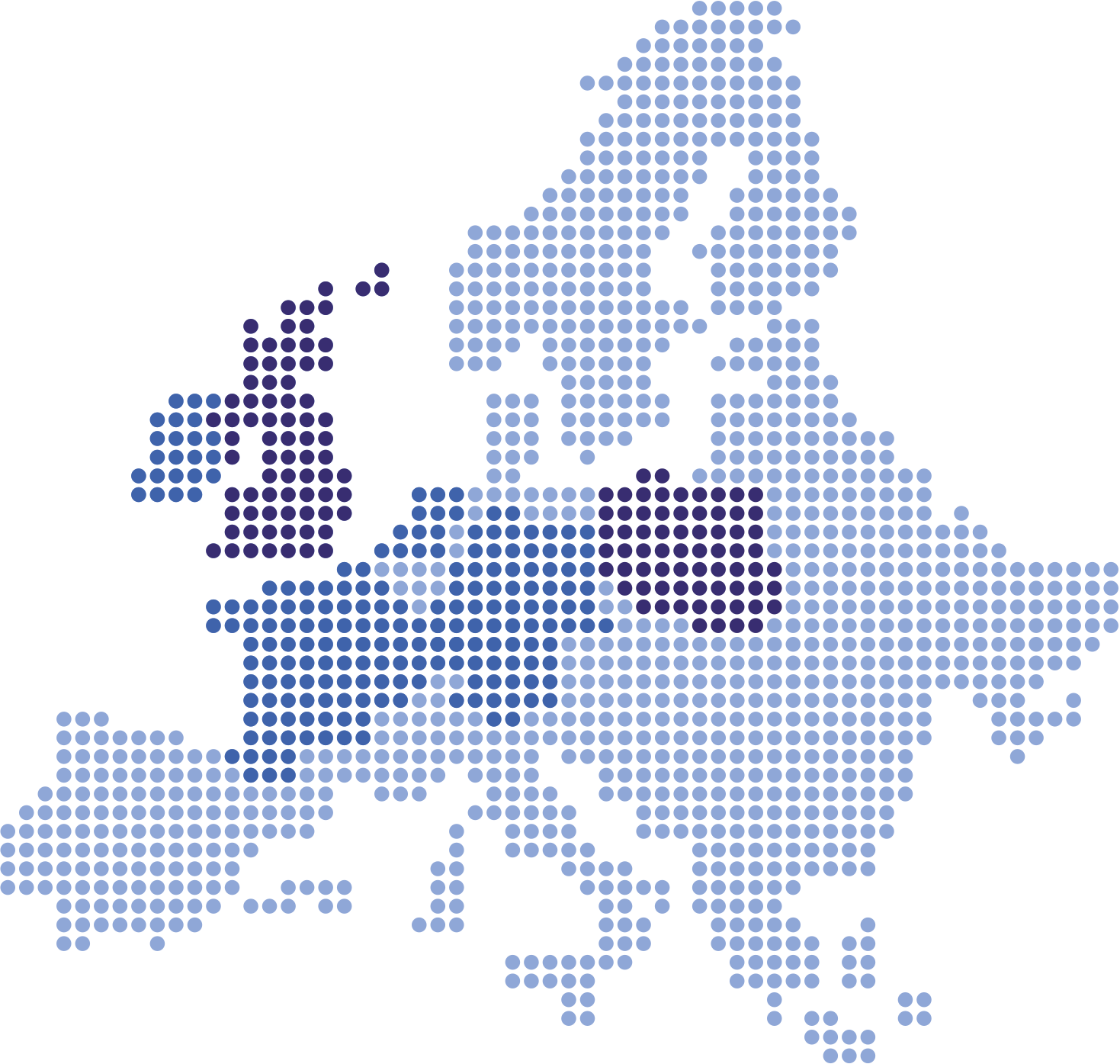
Our branches in the United Kingdom, France, the Netherlands, and Poland cover every major UK–EU trade lane. Whether your freight moves through Dover, Calais, Holyhead, Dublin, Harwich, Rotterdam, or Dunkirk, your safety and security declarations are handled by a local team that knows the port, the system, and the regulators.
Need a customs agency that files EXS and ENS declarations without excuses, 7 days a week? Contact our team for a free consultation — we will walk you through the onboarding process and have your first declaration submitted within 24 hours.